
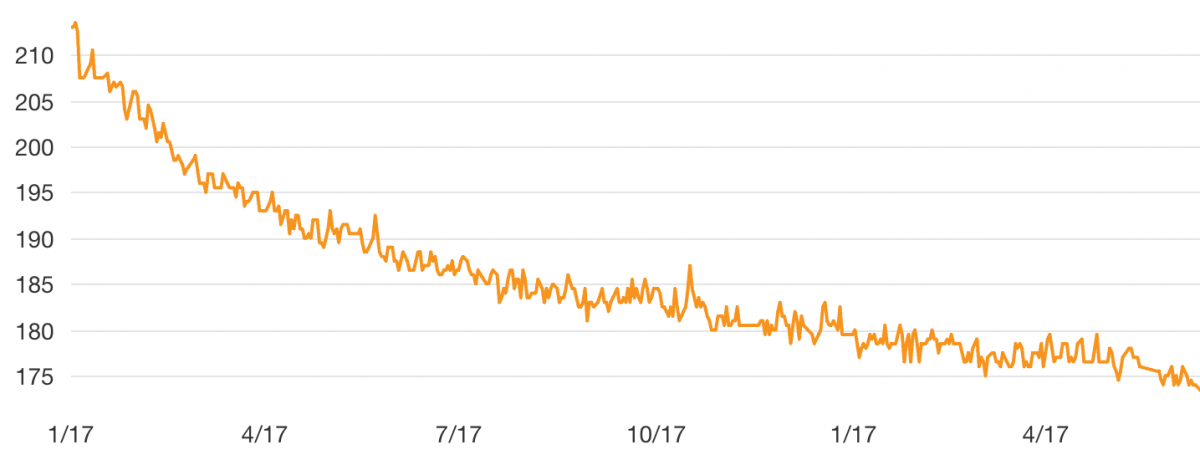
I’ve never seriously considered losing weight, even though over the years my weight slowly increased by a pound a year and my waist size was up 2 inches from where it used to be. At 5’10” with 213 lbs at age 42, I thought I was okay. Hey, I exercised 5 days a week (including intense martial arts, running and tennis), ate decently and was overall pretty healthy. So my weight was probably due to muscles, right?
Beginning the Journey
Whatever it was, in January of 2013 I read something about fitness apps and tracking exercise and calories. On a whim, I downloaded MyFitnessPal and put in my data. I set my target for 200 lbs, which resulted in a daily calorie limit of about 1,800 calories or so. Then I started tracking everything I ate as well as my exercise. Being anal and a little OCD, I quickly became obsessed with making sure all my information was entered properly at all times, including a daily weigh-in. It didn’t take long to realize that 1,800 calories a day isn’t a whole lot. I figured out a number of changes I had to make as far as my diet:
- Cut out the morning OJ to reduce sugar/carbs.
- No more Gatorade after my workouts – I found a sugar-free substitute (Sqwincher Qik Stiks).
- Generally reduce the carbs, even whole wheat variants
- Watch portion size even more than I already had.
- Switch to a uber-healthy and low-calorie 9 PM snacks
When I worked out hard, it gave me “calorie credit”, which allowed me to eat a little bit more. So as an admitted creature of habit, I decided to bump up my routine and exercise 7 days a week, even if that meant getting up at 5:30 on Fridays to go running before work (I usually work out at night). 7 days a week sounds harder than it is and with the right routine is quite doable. I thought my body needed rest days, but it adjusted quite well to working out every day. Tracking everything with MyFitnessPal was immensely helpful and educational. It helped me fine-tune what I was doing and identify little mistakes and areas of improvement. With this app-induced awareness, I was able to start dropping pounds quite consistently.
Getting on Auto-Pilot
Routine – in my case – is the key. I tend to follow the same routines and patterns and they become second nature. In order to really be effective and put my diet on auto pilot, I came to the realization that if I just changed my old routine and established a new one, I could get into a mode of sustained weight loss without having to fight too hard for it. Sticking with it is easiest for me if I don’t have to think about it too much, just follow the established routine.
Example: I used to eat at Quizno’s most weekdays. Even their turkey bacon guacamole sandwich had 700-800 calories. This seemed to be okay before, but thanks for MyFitnessPal, I learned that this wasn’t all that great, I So I changed my routine and started going to Subway almost every day, where a ham sandwich with healthy ingredients and no mayo was in the 400-calorie range. I had read the book Change Everything earlier and two key elements helped me:
- Identify critical moments where I am most likely to go off track and figure out how to avoid falling off the wagon. In my case that was free food catered for meetings at work. So I learned to either walk away (not always easy, especially with free pizza in the lunch room) or reduce the portion size and fill up mostly with salad and just have a little bit of the “bad stuff”.
- Visit your “default future”, which means envisioning myself and what I would look and feel like if I didn’t do anything about my weight. Not always a pleasant thought. Reversely, I started liking to envision myself “ripped” and with a noticeable 6-pack.
After about 2 months I had fine-tuned my understanding of the foods I ate and the exercise I did on my calorie budget. With my new habits, I stopped tracking food and exercise, but still held on to the daily weigh-in. Due to the heightened overall awareness and knowledge I had built, this didn’t negatively affect my weight trajectory.
As the months were coming and going and my weight was consistently dropping, I kept reaching and surpassing my goals. 213 lbs became 200, my original target. I kept going and reached 190. Nice! How does 185 sound? Doable. But at 185, I figured 180 is a nice round number. At 180 I was stoked. I recalled being at 175 lbs when I was in my late 20’s with a 32” waist. So I kept going and made it to 175! And I still kept going. Since everything happened so automatically and without much effort, it was almost easiest to stick to my routing and the weight would drop by itself.
At this time it’s pretty easy to just keep going and I’ve managed to drop to 173 lbs, which means I dropped 40 lbs (19% of my original weight) in about 18 months, which far exceeds all goals I’ve ever set. I am happy to now have the six-pack and noticeable muscle definition in my core I always wanted. And my waist is down to 31”, even less than in my 20’s.
It’s annoying to have to buy new pants and smaller shirts, but it is rewarding when people come and ask whether I lost weight or comment that I look good or thin.
How long will I keep going? I haven’t figured it out yet, but in the mean-time it’s easiest doing what I’ve been doing and seeing where these new habits lead me.
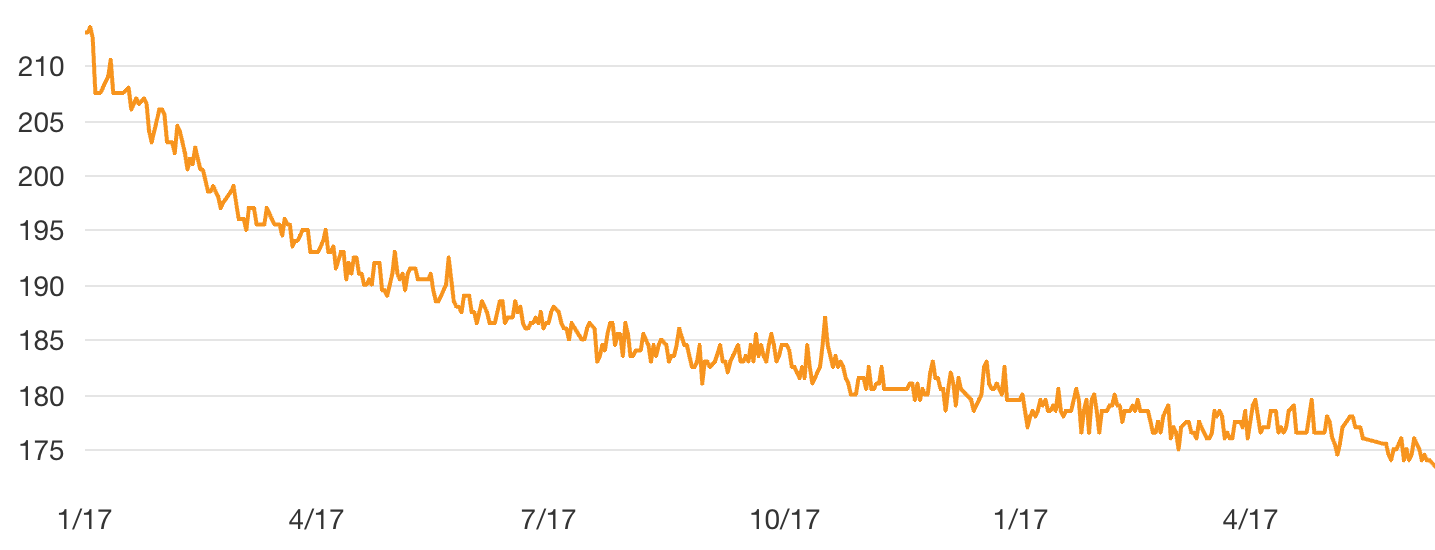 My weight over time
Fine-Tuning
There are a number of things I’ve been tweaking and experimenting with throughout my journey and I’m still tinkering with them.
Here are some of the changes and learnings:
Here are some of the changes and learnings:
- Fill up with low-calorie vegetables and salads with vinaigrette dressing before hitting the main course. It’s easier to control portion size of “dangerous” items when you almost feel full already.
- I try to “skip” one meal a day by replacing it with a liquid meal (e.g. avocado/soy milk shake or Glucerna drink) augmented with carrots, hummus etc. for extra volume and satiation. Something in these nutritional / meal-replacement drinks miraculously keeps you full longer too.
- Not having a steaming meal waiting for me when I come home from work helps. An empty table is far less tempting and helps just reach for a shake and carrots/fruits.
- Fruits are good, but know they do contain a decent amount of sugar, so don’t overdo it.
- I don’t skip breakfast and usually have a light lunch. Instead I tend to “skip” dinner and go with a very light 9 PM snack. The body burns calories earlier in the day and not having much for dinner prevents calories turning into fat over-night. On the contrary, going to bed slightly hungry isn’t fun, but you don’t know you’re hungry when you’re sleeping.
- After a light breakfast, I found out that mixing some whey protein powder into a glass of soy milk keeps me feeling full longer.
- I snack on unsalted peanuts during the day. I eat way less if they’re unsalted and don’t have to drink as much. I also like Corazonas bars. Snacking on good stuff helps me not feel hungry throughout the day.
- If you fill up with plenty of liquids, including water, you will feel less hungry.
- Eating protein in the morning, e.g. egg whites, keep you full longer than carbs or insoluble fiber.
- My family and I eat out on Friday and Saturday night and I drink lots of Diet Pepsi. I learned that it’s okay if my weight seems to go up over the weekend. Come Monday, I’ll be okay again and continue my slide down.
- Since we go out for dinner Friday and Saturday night, I switch things on these days and try to skip lunch on those days (read shake). A grande, unsweetened Starbucks iced coffee with soy milk will help me feel full after lunch (and it’s a little reward).
- I weigh myself at the same time every day to compare “apples to apples”, i.e. right before going to bed.
- If you want to skip lunch, leave the office and go somewhere, walk around etc. It’ll distract you from the fact that you’re not eating.
- Nuts and seats are your friend. As a matter of fact, you can turn chia seeds with a few oat flakes, raisins and soy milk into a cereal/snack.
- Cheese sticks and turkey jerky make good filler snacks. Did I mention carrots yet?
- Hummus is full of good stuff and low in calories.
- (Greek) yoghurt is good for you, but watch the sugar.
- Skip the rice, pasta and other starchy sides and just go for lean meat and vegetables.
- Watch for rich sauces and dressings or mayo.
- A little dark chocolate is good for you.
- When watching TV, I started doing push-ups, sit-ups, crunches, planks, leg lifts, etc. Your body weight is sufficient to build strengths for most of your body – no fancy equipment is needed. (Only exception: biceps. Haven’t figured that part out yet.)
- I just got a set of resistant bands and am experimenting with different arm and shoulder exercises – also while watching TV. A massage roller can also be a good way to change things up.
- The more weight I lost, the easier the strength training goes and the longer I can run, which in turn helps burn more calories. This is a self-enforcing cycle in a way.
- Running in the morning right after getting out of bed is tough on your body. Have a shake or yoghurt before you head out and start slow. My joints tend to ache a little until I stop to stretch 5 minutes into the run. After I start to feel better and my body has finally figured out that the warm bed is now history.
- I’ve always had knee issues since I was a teenager, but switching to a mid-foot strike instead of heel strike running style paired with light, more minimalist shoes (<= 4 mm heel-to-toe drop, e.g. Brooks PureConnect or Altra “The One”) have helped me run longer and pretty much eliminated my knee issues.
- Do different workouts and mix it up, so no one part of your body get consistently fatigued. While one part is recovering/rebuilding, the other is getting a workout. I do martials arts, run and play tennis every week. Where possible, I add hiking and swimming. Don’t slack off when you’re traveling.
- I’d love to use a fitness tracker (Nike FuelBand, Jawbone Up, etc.), but since I can’t wear it during Tae Kwon Do, I’d always be missing out on my main workouts. For running, I like my iPod nano since running with music is more fun and it tracks time and distance. (I tried a heart rate monitor too, but hated the chest strap.)
- Your weight will fluctuate based on meals, times of eating, how much liquid you’ve had post workout, and other factors. Expect little ups and downs of up to 1 lbs a day even if you “do everything right”. Week over week is a better for comparison purposes and gauging success than day over day.
- This isn’t a sprint (despite early successes). This is a lifestyle change.
- Read about working out and nutrition.
- Get rid of clothes that are now too loose and baggy. It can be fun to get a new wardrobe and you’ll never need those big clothes again, right? If you toss them, you’ve mentally eliminating the “way back”. This should be a one-way street.
These are just my learnings. Your mileage will vary. Key is to figure out what works for you and stick with it. Be open to try new stuff.
Net/Net
Admittedly not everyone is like me. But in my case, building self awareness and creating new habits that become second nature were key to my success. Other people may not be as routine-oriented, but nonetheless, a lot of the things I’ve learned will be transferrable. I feel good (and hopefully look better), am healthy, have good energy, and am happy with the new me. I plan on keeping at it. After all, it’s hard to break with my habits.
Was this helpful? Please leave a comment, I’d like to hear from you…
Leave a Reply